Joel's Comments — v30.3 Manuscript
Joel Bregman's annotated PDF comments on the v30.3 manuscript — 29 annotations across 13 pages, with location, comment text, and evaluation.
Joel Bregman's annotated PDF comments on the v30.3 manuscript — 29 annotations across 13 pages, with location, comment text, and evaluation.
29
Annotations
13
Pages
28
By Joel
1
By Rui
#1
Page 2
Anchored text
in major X-ray surveys (Mateos et al. 2008; Georgakakis et al. 2008; Cappelluti et al. 2009; Laird 45 et al. 2009; Puccetti et al. 2009; Xue et al. 2011; Wang et al. 2016; Luo et al. 2017, e.g.,). The 46
Joel's comment
(Highlight only — no text comment)
Suggestion and evaluation
Highlight only, marking the "e.g.,)" at the end of the reference list. Suggestion: check that the citation format is correct here; "e.g.,)" may need to become "e.g.)" or have the redundant comma removed.
#2
Page 2
Anchored text
empirical, position-dependent residual calibration, yielding a mean/median-threshold 22 fitted-amplitude calibration with 11% uncertainty at DET ML = 6 for the preferred 2D 23 interpolation (17% nearest-calibration-position fallback), validated against held-out de- 24 tector positions, with weak background dependence across b = 0.02–0.08 counts pixel−1.
Joel's comment
(Highlight only — no text comment)
Suggestion and evaluation
Highlight only, marking the key sentence in the abstract about the 11% uncertainty. Suggestion: this information is important; consider emphasizing it in bold or italics.
#3
Page 3
Anchored text
itself departs from its high-count χ2 limit in the low-count Poisson regime (Bonamente 2020). Our 58 use of the DET ML–∆C conversion is therefore purely operational: it maps a detection threshold 59 chosen by the survey analyst into the corresponding ∆C value, where the observable-conditioned 60
Joel's comment
(Highlight only — no text comment)
Suggestion and evaluation
Highlight only, marking the word "operational:". Suggestion: make sure the meaning of "operational" is sufficiently clear in context; a clarifying sentence may be needed.
#4
Page 3
Anchored text
no longer represents the untruncated parent distribution (Eddington 1913; Wang 2004). 67 The core challenge is not the absence of a predictable mean. The expected ∆C at a fitted source 68 has long been computed analytically and used as a single deterministic value in X-ray sensitivity-map 69 construction. Within the SAS itself, esensmap carries an emldetect-style analytical Cash-statistic
Joel's comment
This is a bit dangling and you should say where it's going.
Suggestion and evaluation
Joel points out that this is left "dangling" — the core challenge is raised but the paper does not say where it is heading. Suggestion: add a transition sentence at the end of the introduction paragraph, e.g. "We address this by constructing the full sampling distribution p(ΔC|S,B,Θ) in Section 4–6."
#5
Page 4
Anchored text
has not done is treat ∆C as a sample from a non-trivial sampling distribution. 75 Yet the distributional moments are inputs that any systematic treatment of Eddington bias or flux- 76 limit precision must eventually incorporate. While this work does not construct a full Eddington-bias 77
Joel's comment
(Highlight only — no text comment)
Suggestion and evaluation
Highlight only, marking the paragraph on ΔC as a sampling distribution. Suggestion: this is the paper’s core innovation; consider emphasizing it more explicitly.
#6
Page 4
Anchored text
a slowly-varying scalar residual in detector-position space. The theory itself closes in the high-signal 81 regime; in the threshold band where DET ML = 6–10, an empirical residual calibration absorbs the 82 beyond-Fisher bias and the implementation-dependent o↵set of standalone emldetect. The pipeline- 83 reported detection-likelihood statistic, however, is a nonlinear incomplete-gamma transform of ∆C
Joel's comment
These are two sentences, so use a period instead of several semi-colons
Suggestion and evaluation
Joel points out that two independent sentences are separated by semicolons and should use a period. Suggestion: search the full text for the semicolon-separated-sentence pattern and change them all to periods.
#7
Page 19
Anchored text
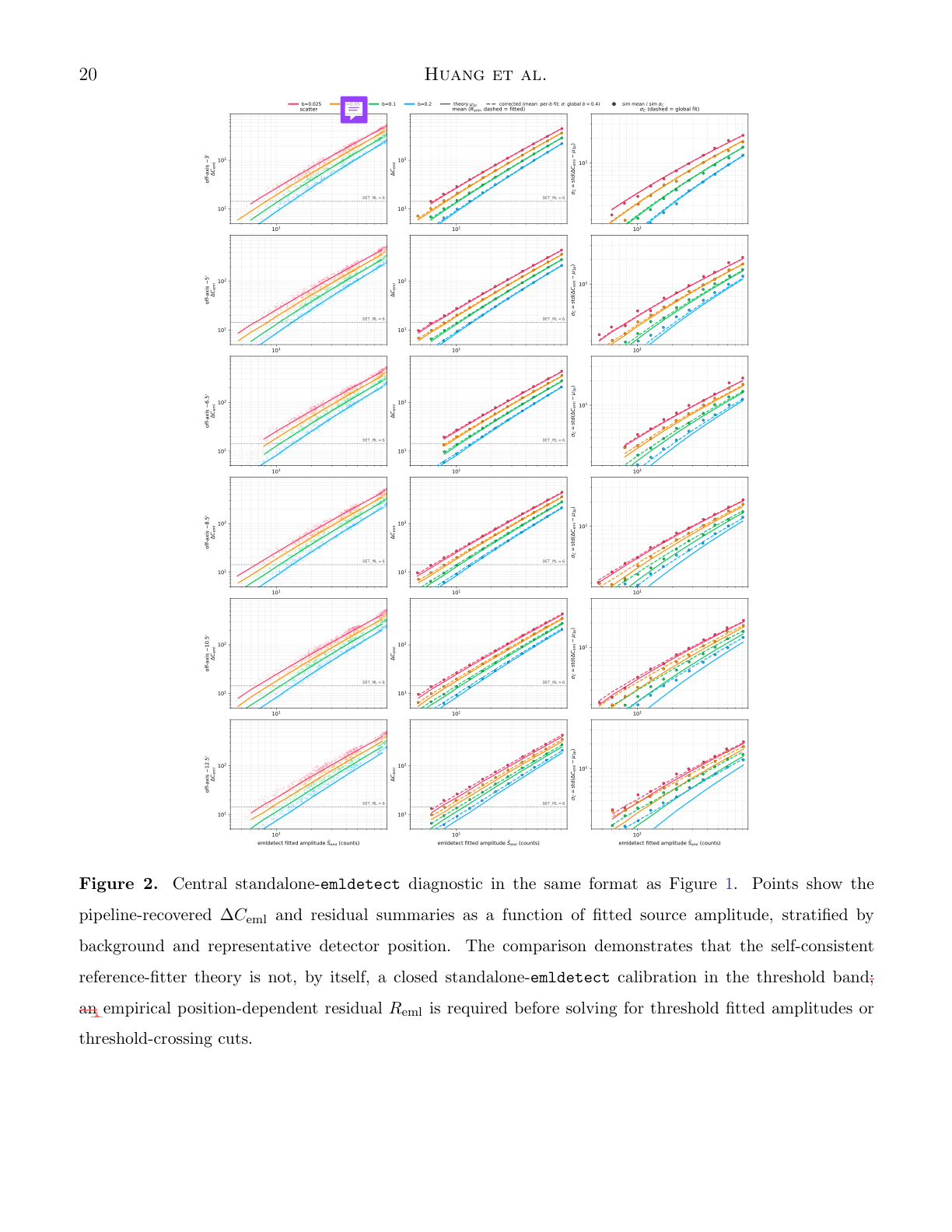
8, and 13.3% at DET ML = 10. The error is position-dependent rather than a single scalar o↵set. 398 Figure 2 is the central diagnostic for the operational standalone-emldetect chain. It is deliberately 399 parallel to Figure 1: the same observable-conditioned structure remains visible, but the standalone 400 pipeline introduces a position-dependent residual relative to the reference-fitter theory. This is the 401
Joel's comment
(Highlight only — no text comment)
Suggestion and evaluation
Highlight only, marking the Figure 2 description paragraph (whole paragraph highlighted). Suggestion: this description is long; consider trimming it.
#8
Page 19
Anchored text
Figure 2 is the central diagnostic for the operational standalone-emldetect chain. It is deliberately 399 parallel to Figure 1: the same observable-conditioned structure remains visible, but the standalone 400 pipeline introduces a position-dependent residual relative to the reference-fitter theory. This is the 401
Joel's comment
and is similar
Suggestion and evaluation
Joel wrote "and is similar" — possibly suggesting that a comparison with Figure 1 be added here. Suggestion: check whether the context already states the parallel with Figure 1 sufficiently.
#9
Page 19
Anchored text
Figure 2 is the central diagnostic for the operational standalone-emldetect chain. It is deliberately 399 parallel to Figure 1: the same observable-conditioned structure remains visible, but the standalone 400 pipeline introduces a position-dependent residual relative to the reference-fitter theory. This is the 401
Joel's comment
(Highlight only — no text comment)
Suggestion and evaluation
Highlight only, marking the "the" in the Figure 2 description. Suggestion: Joel may be flagging the wording here for revision.
#10
Page 19
Anchored text
Figure 2 is the central diagnostic for the operational standalone-emldetect chain. It is deliberately 399 parallel to Figure 1: the same observable-conditioned structure remains visible, but the standalone 400 pipeline introduces a position-dependent residual relative to the reference-fitter theory. This is the 401
Joel's comment
The
Suggestion and evaluation
Joel wrote "The" — possibly flagging the wording for revision. Suggestion: check whether the start of this sentence needs adjustment.
#11
Page 20
Anchored text
pipeline-recovered ∆Ceml and residual summaries as a function of fitted source amplitude, stratified by background and representative detector position. The comparison demonstrates that the self-consistent reference-fitter theory is not, by itself, a closed standalone-emldetect calibration in the threshold band; an empirical position-dependent residual Reml is required before solving for threshold fitted amplitudes or threshold-crossing cuts.
Joel's comment
(Highlight only — no text comment)
Suggestion and evaluation
Highlight only, marking the paragraph on the reference-fitter theory not being a closed calibration. Suggestion: this is a key conclusion; consider emphasizing it.
#12
Page 20
Anchored text
reference-fitter theory is not, by itself, a closed standalone-emldetect calibration in the threshold band; an empirical position-dependent residual Reml is required before solving for threshold fitted amplitudes or threshold-crossing cuts.
Joel's comment
. An
Suggestion and evaluation
Joel wrote ". An" — possibly suggesting a period plus "An" in place of the semicolon. Suggestion: change "; an empirical" to ". An empirical", consistent with the semicolon issues in #6 and #18.
#13
Page 20
Anchored text
20 Huang et al.
Joel's comment
The text is almost unreadable now and will be worse when printed.
Suggestion and evaluation
Joel points out that the text here is almost unreadable and will be worse when printed. Suggestion: check the page layout/font size — possibly an AASTeX compilation issue or overly tight line spacing. Make sure the final published version is readable.
#14
Page 21
Anchored text
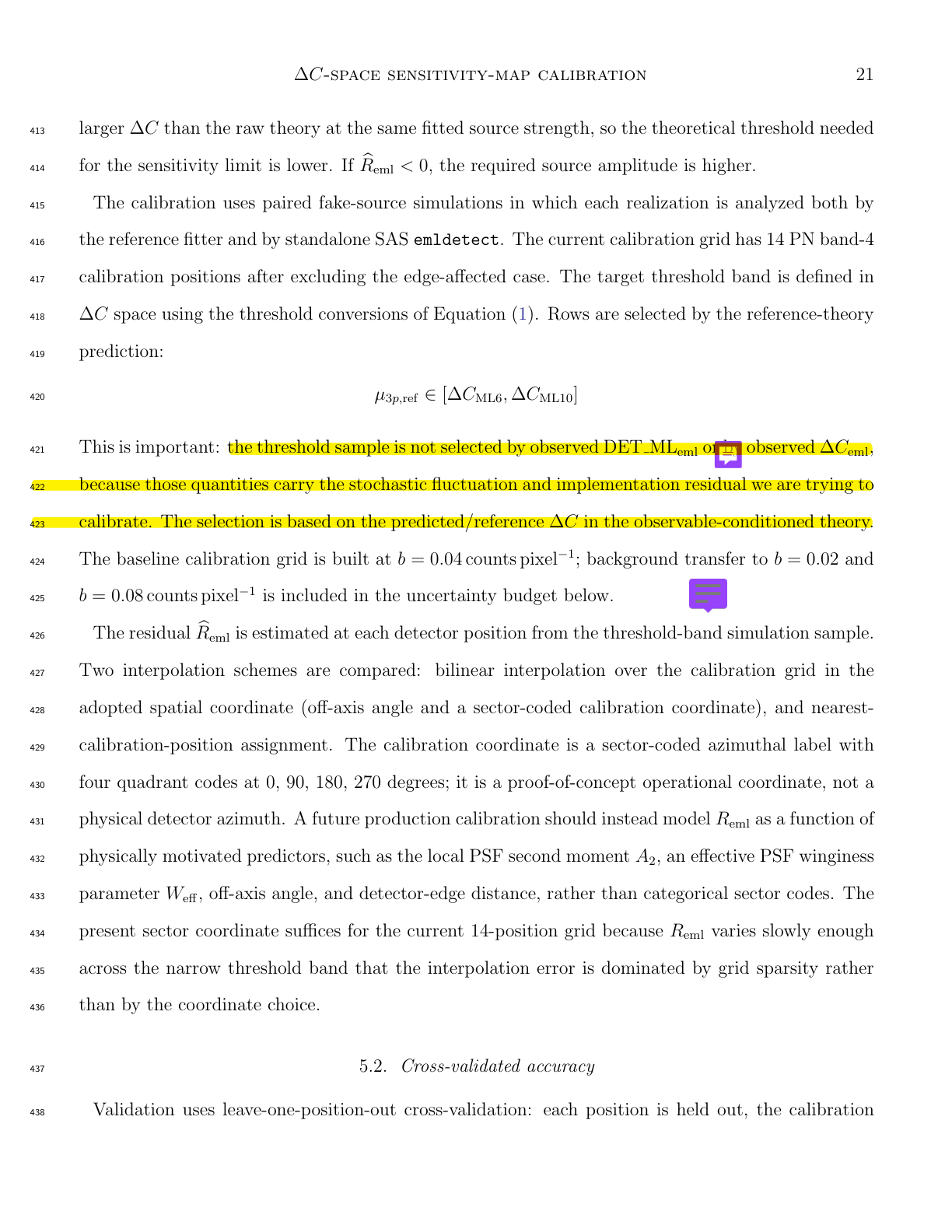
µ3p,ref 2 [∆CML6, ∆CML10] 420 This is important: the threshold sample is not selected by observed DET MLeml or by observed ∆Ceml, 421 because those quantities carry the stochastic fluctuation and implementation residual we are trying to 422 calibrate. The selection is based on the predicted/reference ∆C in the observable-conditioned theory.
Joel's comment
These These sentences are very important and you might want to emphasize them a bit more or at least put them in italics or all parts of them in boldface.
Suggestion and evaluation
Joel considers these sentences very important and suggests emphasizing them in italics or bold. Suggestion: set "This is important: the threshold sample is not selected by observed DET_ML or ΔC" in bold or italics.
#15
Page 21
Anchored text
calibrate. The selection is based on the predicted/reference ∆C in the observable-conditioned theory. The baseline calibration grid is built at b = 0.04 counts pixel−1; background transfer to b = 0.02 and 424 b = 0.08 counts pixel−1 is included in the uncertainty budget below. 425 The residual bReml is estimated at each detector position from the threshold-band simulation sample. 426
Joel's comment
This sector-coded azimuth issue is an essential point, but then you repeat it in the next sections rather than referncing it
Suggestion and evaluation
Joel points out that the sector-coded azimuth is an essential point, but later sections repeat it instead of referencing it. Suggestion: detail it in §5.2 and have later sections refer to it as "as discussed in §5.2".
#16
Page 21
Anchored text
µ3p,ref 2 [∆CML6, ∆CML10] 420 This is important: the threshold sample is not selected by observed DET MLeml or by observed ∆Ceml, 421 because those quantities carry the stochastic fluctuation and implementation residual we are trying to 422 calibrate. The selection is based on the predicted/reference ∆C in the observable-conditioned theory. 423 The baseline calibration grid is built at b = 0.04 counts pixel−1; background transfer to b = 0.02 and 424
Joel's comment
(Highlight only — no text comment)
Suggestion and evaluation
Highlight only by Rui Huang, marking the key paragraph on the observable-conditioned theory. Suggestion: together with #14, this paragraph is indeed worth emphasizing.
#17
Page 22
Anchored text
is built from the remaining positions, and the predicted Slim is compared to the held-out position’s 439 internally calibrated reference limit. This held-out reference limit, Sref, is defined using the same 440 reference fitter that is used throughout Section 4: for each simulated source strength, the median 441
Joel's comment
It seems like a form of bootstrap.
Suggestion and evaluation
Joel thinks this looks like a form of bootstrap. Suggestion: state explicitly in the text that this is not bootstrap — bootstrap resamples data, whereas here it is leave-one-position-out cross-validation; the two mechanisms differ. A clarifying sentence can be added.
#18
Page 22
Anchored text
calibration’s ability to self-consistently interpolate the pipeline’s own threshold mapping across the 446 calibration grid; it is not an absolute astrophysical validation against independent observational data 447 or against injection-recovery detection fractions. Such absolute validation, for example comparing the 448 predicted Slim against an injection-recovery 50% completeness flux from dense fake-source injection 449
Joel's comment
Stop with the semi-colons separating two sentences -- just have two sentences.
Suggestion and evaluation
Joel again raises the semicolon-separated-sentences issue. Suggestion: consistent with #6, change the semicolons to periods. This is a paper-wide issue and needs a uniform fix.
#19
Page 23
Anchored text
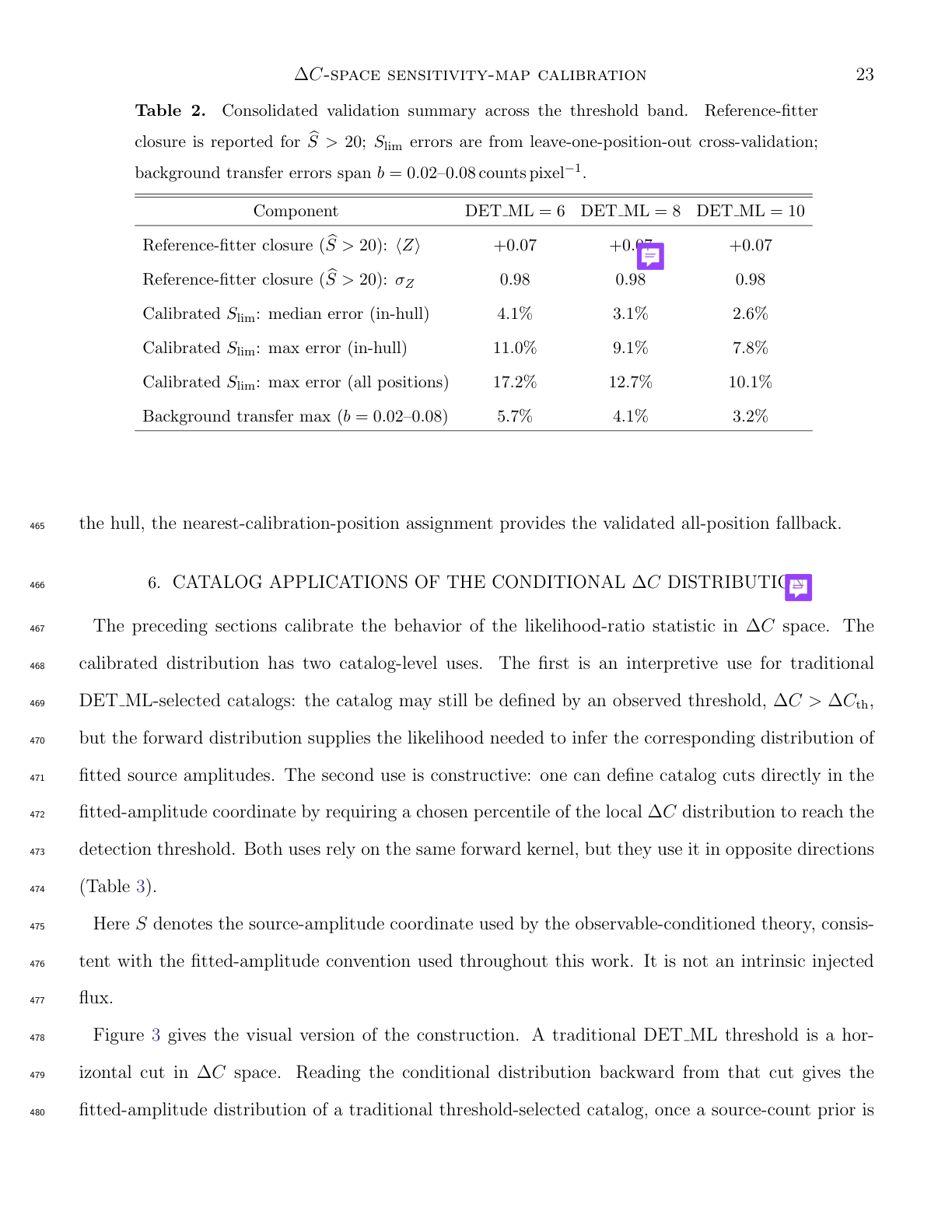
b Component DET ML = 6 DET ML = 8 DET ML = 10 Reference-fitter closure (bS > 20): hZi +0.07 +0.07 +0.07 Reference-fitter closure (bS > 20): σZ 0.98 0.98 0.98 Calibrated Slim: median error (in-hull) 4.1% 3.1% 2.6%
Joel's comment
why are all <Z> values the same (ditto for sigma_Z -- is this part of the closure?
Suggestion and evaluation
Joel asks why all ⟨Z⟩ values are the same (ditto for σZ). Suggestion: add a sentence in the Table 3 caption or the body explaining — because the reference-fitter closure at bS > 20 does not depend on DET_ML, identical closure statistics across all DET_ML bins are expected.
#20
Page 23
Anchored text
the hull, the nearest-calibration-position assignment provides the validated all-position fallback. 465 6. CATALOG APPLICATIONS OF THE CONDITIONAL ∆C DISTRIBUTION 466 The preceding sections calibrate the behavior of the likelihood-ratio statistic in ∆C space. The 467
Joel's comment
There are some really good things in this section, such as table three, table four, figure three. There is a lot of redundancy here. The backward/forward distinction is made in several places. There is the validation still needed issue that is back in section 5 and also in section 7. There is the disclaimer about the fitted amplitude vs. intrinsic flux, which is in:
- section 2, the intro
- section 6, table 3 note
- section 6.2
- and again in 7
Just pick one location and you can make the rest of it just a clause here and there.
Suggestion and evaluation
Joel points out that this section has good content (Table 3/4, Figure 3), but too much redundancy: the backward/forward distinction, the validation-needed caveat, and the fitted-amplitude vs intrinsic-flux disclaimer are all repeated. Suggestions: (1) keep the fitted-amplitude disclaimer only in §2 and reduce the rest to one clause; (2) detail the backward/forward distinction in one place only; (3) keep the validation-needed caveat only in §7.
#21
Page 24
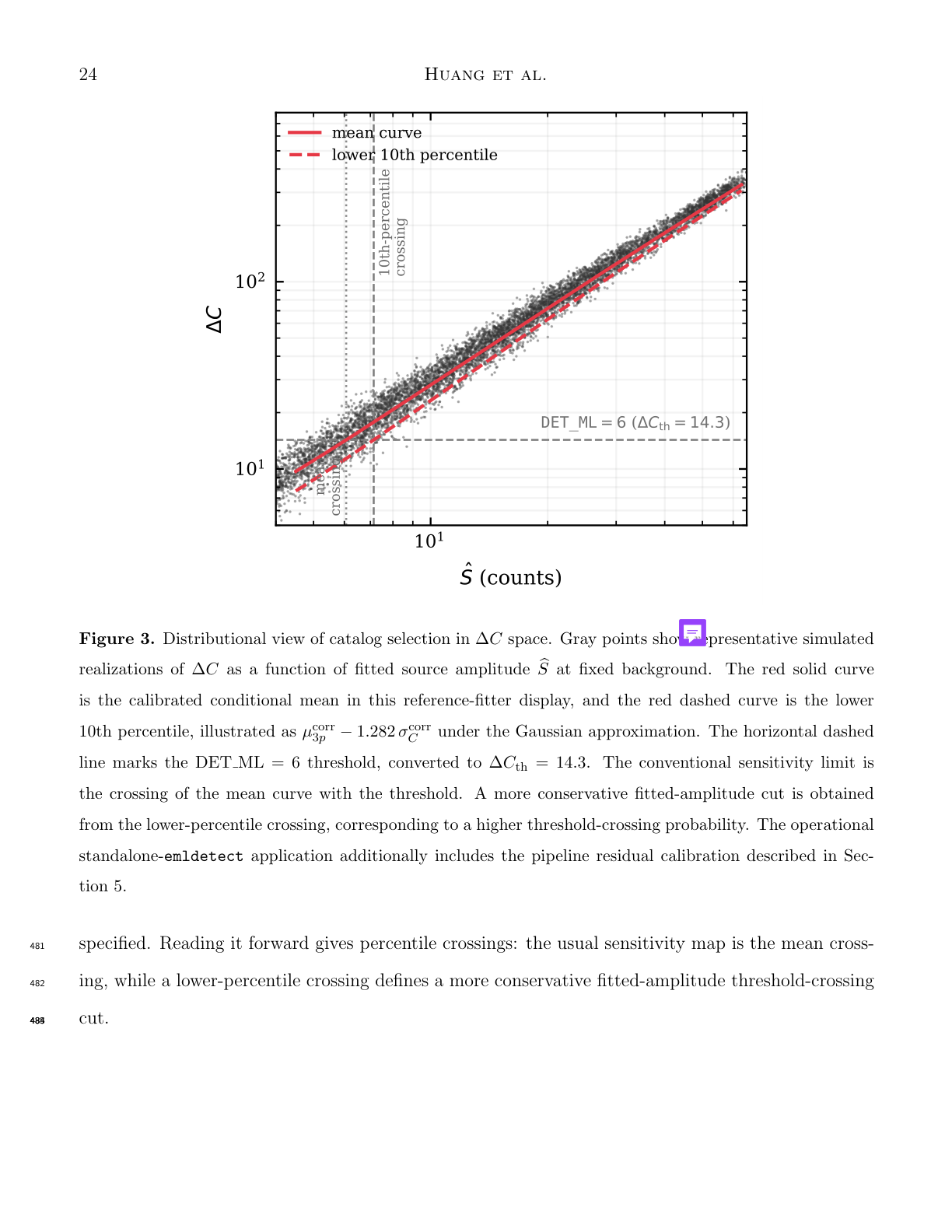
Anchored text
Figure 3. Distributional view of catalog selection in ∆C space. Gray points show representative simulated realizations of ∆C as a function of fitted source amplitude bS at fixed background. The red solid curve is the calibrated conditional mean in this reference-fitter display, and the red dashed curve is the lower
Joel's comment
A lot of the text in the figure caption is repeated in the body of the paper with very few changes. You need to trim down in either the figure caption or the text body.
Suggestion and evaluation
Joel points out that the Figure 3 caption repeats the body text too much. Suggestion: trim the caption to the necessary figure description and move the detailed analysis into the body.
#22
Page 29
Anchored text
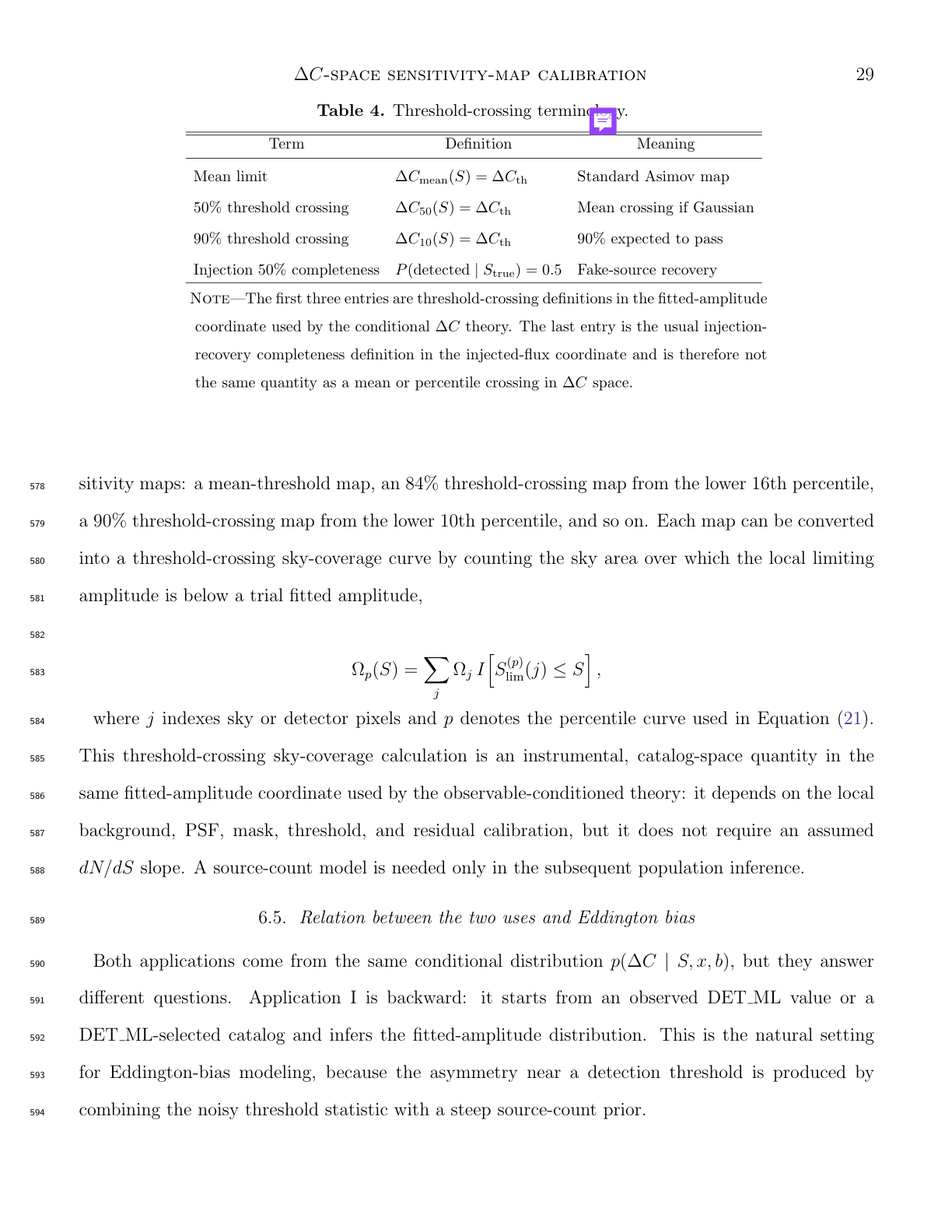
∆C-space sensitivity-map calibration 29 Table 4. Threshold-crossing terminology. Term Definition Meaning Mean limit ∆Cmean(S) = ∆Cth Standard Asimov map
Joel's comment
This is a good table but I am wondering if it should have appeared earlier.
Suggestion and evaluation
Joel thinks Table 4 is a good table but should appear earlier. Suggestion: consider moving Table 4 (the glossary) near §3 or §4, so the terms are defined on first use.
#23
Page 30
Anchored text
7. SCOPE AND LIMITATIONS 618 The presented framework focuses on methodological advances: the conditional-mean formula, the 619 Fisher-projected variance, and the observable-conditioning principle transfer algebraically to any 620
Joel's comment
in a list after the colon, separate items in the list by a semi-colon (not a comma)
Suggestion and evaluation
Joel points out that items in a list after a colon should be separated by semicolons, not commas. Suggestion: change "the conditional-mean formula, the Fisher-projected variance, and" to "the conditional-mean formula; the Fisher-projected variance; and".
#24
Page 30
Anchored text
Zenodo archive. 617 7. SCOPE AND LIMITATIONS 618 The presented framework focuses on methodological advances: the conditional-mean formula, the 619
Joel's comment
I like this section a lot, as it discusses how it can be applied, or not applied, to XMM observations and data sets.
It does over lap with sec. 6.6 and 8 pretty heavily.
The reader sees these limitations repeated several times, making him or her wonder whether or not this work is weaker than it actually is.
Suggestion and evaluation
Joel likes this section a lot (§7 Scope and Limitations), but points out that it overlaps heavily with §6.6 and §8, which would make readers think the work is weaker than it is. Suggestion: merge the §7/§6.6 overlap, and do not repeat the limitations again in the §8 conclusions.
#25
Page 32
Anchored text
If no Reml calibration grid is available, the uncalibrated theory may be used as an approximate esti- 650 mate, with a maximum Slim error of 19.9% at DET ML = 6. This is a fallback, not the recommended 651 calibrated method. If the target setup di↵ers from the validated domain, the calibration should be 652
Joel's comment
approach
Suggestion and evaluation
Joel wrote "approach" — possibly flagging the wording for revision. Suggestion: check whether "the uncalibrated theory may be used as an approximate approach" needs rewording.
#26
Page 32
Anchored text
source PSF fit under the SAS single-image convention (⌫ = 3, shape = 1.5; DET ML = 667 −ln Q(1.5, ∆C/2), so that DET ML = 6, 8, 10 correspond to ∆C = 14.3, 18.6, 22.8). Treating 668 ∆C as a sampling distribution rather than as a single deterministic value is what distinguishes this 669 framework from the prior analytical-mean sensitivity-map literature.
Joel's comment
Consider emphasizing this sentence by italics or bold.
Suggestion and evaluation
Joel suggests emphasizing this sentence. Suggestion: set "Treating ΔC as a sampling distribution rather than as a single deterministic value is what distinguishes this framework" in bold or italics.
#27
Page 32
Anchored text
8. CONCLUSIONS 662 The conditional mean of the Cash-statistic improvement at a fitted source, 663 664
Joel's comment
After a Complicated papers, such as this one, I think that the conclusions are a very important point. Having said that you don't need to argue again about certain points although one should certainly state them. This is that redundancy issue I was mentioning.
Suggestion and evaluation
Joel points out that the conclusions should state results directly rather than re-arguing them. Suggestion: §8 Conclusions should only state the conclusions and key results, not repeat the §7 limitations argument. Consistent with the redundancy issue in #20.
#28
Page 35
Anchored text
ACKNOWLEDGMENTS 713 We acknowledge support from the National Natural Science Foundation of China. This research has 714 made use of data obtained from the XMM-Newton satellite, an ESA science mission with instruments 715
Joel's comment
This may be true , but if it is to be published and paid for by a NASA grant, you can't have this sentence. We would put one in acknowledging the NASA grant and that nobody from the PRC participated. If it is paid for by an institution in the PRC (and not NASA), then you can leave it in. We might want to talk about this.
Suggestion and evaluation
Joel points out that if published under a NASA grant this sentence (an NSFC acknowledgment) cannot stay; it would have to become a NASA acknowledgment stating no PRC involvement, whereas if funded by a PRC institution it can remain. Suggestion: decide based on the actual funding source. If both NSFC and NASA funding exist, acknowledge them separately and make each scope of contribution explicit.
#29
Page 35
Anchored text
and contributions directly funded by ESA Member States and NASA. 716 REFERENCES Bonamente, M. 2020, arXiv e-prints. 717 Broos, P. S., Townsley, L. K., Feigelson, E. D., 719
Joel's comment
Replace the arXiv links with the links to published papers.
Suggestion and evaluation
Joel suggests replacing the arXiv links with links to the published papers. Suggestion: check all arXiv citations in the reference list and replace them with the published-version DOI/link. Especially Bonamente 2020.